

All-on-Four and All-on-Six
All-on-4 and All-on-6 fixed implant dentures for completely edentulous jaws in Kırşehir. Digital planning at Ayaz Dent; same-day temporary teeth available for suitable cases.
All-on-Four and All-on-Six Implant Treatment in Kırşehir
Kırşehir All-on-Four and All-on-Six implant treatment: provides information on fixed prosthesis planning, application stages, differences, and the healing process in cases of complete edentulism.
The loss of all teeth in the upper or lower jaw can have significant effects on chewing, speech, and social life. While traditional removable dentures provide a functional solution for many patients, the need for alternative treatment options may arise due to denture movement, insufficient retention, or failure to meet expectations for fixed teeth. All-on-Four and All-on-Six implant treatments are considered to support fixed full-arch dentures in patients who are completely edentulous or whose remaining teeth cannot be preserved to a significant extent.
The goal of these systems is not to use a separate implant for every missing tooth in the jaw. A specified number of implants are placed in strategic locations, and a single-piece or segmented fixed prosthesis is supported by these implants. However, the choice between four or six implants is not determined solely by cost, age, or the patient’s preference. The volume of the jawbone, the position of anatomical structures, the occlusal relationship, the design of the prosthesis, and its cleanability must all be evaluated together.
At Ayaz Dent Dental Clinic in Kırşehir Center, during full-arch implant planning, the surgical and prosthetic phases are not treated as separate steps but as complementary parts of the same treatment.
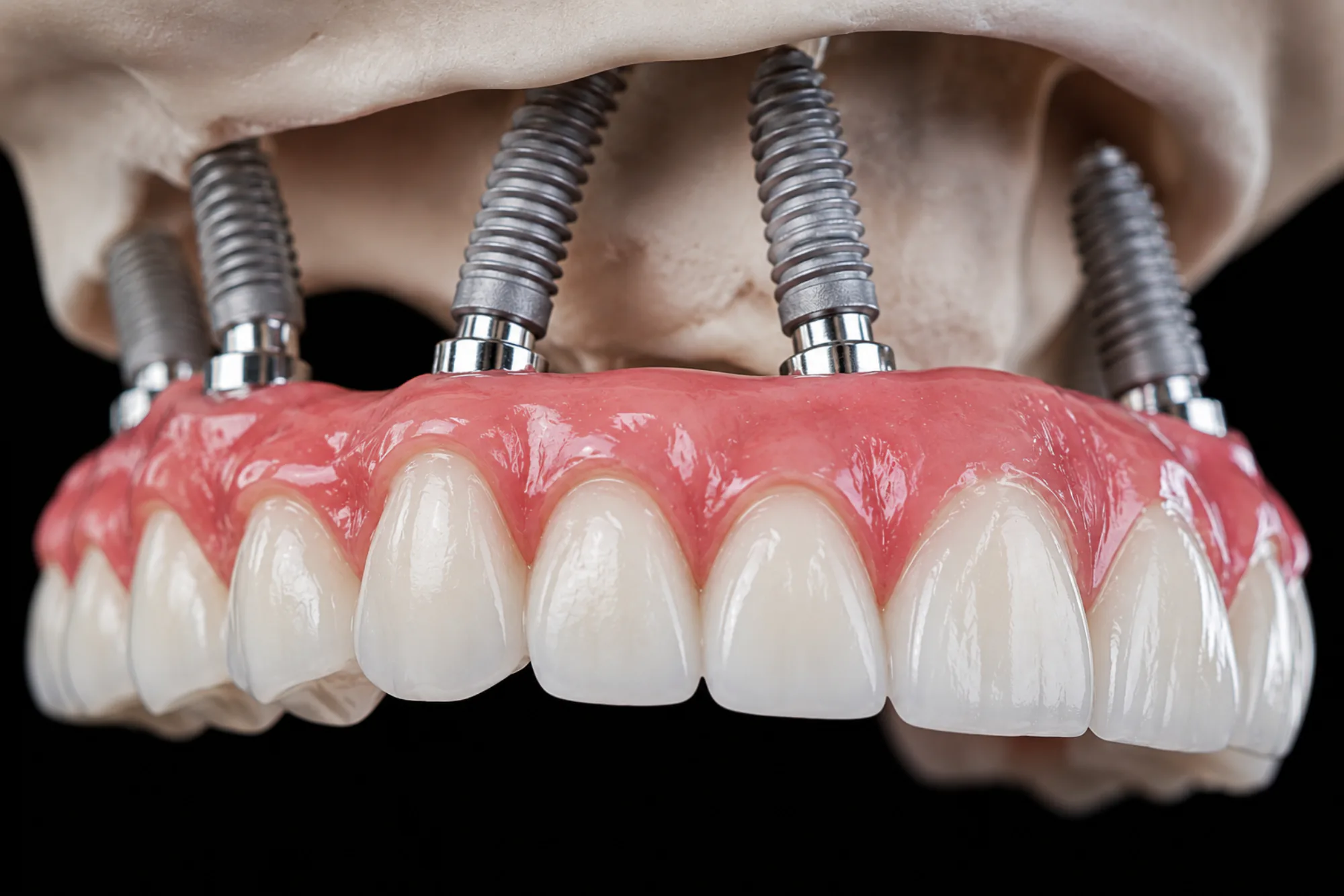
What Are All-on-Four and All-on-Six?
All-on-Four is a treatment approach in which a full-arch fixed prosthesis is typically planned to be supported by four implants. Implants in the anterior region are usually placed more vertically, while those in the posterior region may be placed at an angle depending on anatomical conditions. Angled placement of the posterior implants can help maximize the use of available bone and expand the prosthesis’s support area.
In the All-on-Six system, 6 implants are typically placed in the same jaw. Two additional implants, when bone conditions permit, help increase the number of support points and distribute the forces acting on the prosthesis over a wider area. However, using six implants does not automatically guarantee better results for every patient. The position and distribution of the implants, the quality of the bone, and the prosthesis design are just as important as the number of implants.
In both approaches, treatment may include the stages of a fixed temporary prosthesis and a permanent prosthesis prepared after healing. While it is possible to place the temporary prosthesis within a short time in suitable cases, the same-day fixed denture option is not applicable to all patients.
How Is the All-on-Four System Planned?
In the All-on-Four approach, the distribution of implants on the jaw is designed to make efficient use of the existing bone. In some cases, particularly where bone height is limited in the posterior regions, placing the implants at a specific angle can reduce the need for advanced bone augmentation procedures. However, this method does not eliminate the need for bone grafting or sinus floor elevation in all cases.
To evaluate a full-arch treatment with four implants, the implants must be placed at appropriate intervals, sufficient initial stability must be ensured, and the prosthesis must be designed to distribute forces evenly. Prosthesis extensions left longer than necessary in the posterior region may increase the load on the implants and prosthetic components and should therefore be carefully evaluated during planning.
In which cases can the All-on-Four approach be considered?
- Complete edentulism in the upper or lower jaw
- When long-term preservation of existing teeth is not feasible
- Preference for a fixed option over a removable denture
- Limited bone volume in the posterior region
- The ability to achieve an appropriate biomechanical distribution with four implants
- The patient’s ability to maintain oral hygiene and attend regular checkups
How Is the All-on-Six System Planned?
In All-on-Six treatment, a fixed full-arch prosthesis is supported by six implants. In patients with adequate jawbone, the implants can be planned to be placed with a wider distribution across the jaw. This distribution can help distribute the chewing forces acting on the prosthesis to different support points.
For a six-implant plan, there must be sufficient bone, and the implants must be placed in appropriate areas without being positioned too close to one another. Sinuses, nerve canals, and bone volume loss can limit implant placement. Therefore, All-on-Six should not be viewed simply as “two more implants”; it requires a distinct surgical and prosthetic plan.
In which cases can All-on-Six be considered?
- Sufficient bone volume along the jaw
- The six implants must be positioned at appropriate intervals
- Prosthetic plans requiring a broad distribution of support
- The goal of balanced distribution of chewing forces
- Ability to adhere to a long-term maintenance and follow-up program
Who Is a Candidate for All-on-Four and All-on-Six?
These treatments can be considered for completely edentulous patients whose jaw development is complete and whose general health is suitable for implant surgery. Additionally, full-arch rehabilitation can be planned for patients whose existing teeth cannot be preserved due to advanced decay, widespread gum disease, fractures, or failed restorations.
The eligibility assessment does not consider only the number of teeth in the mouth. The patient’s medications, diabetes control, cardiovascular diseases, conditions affecting bone metabolism, smoking habits, and previous treatments are also evaluated. Active gum infections and oral inflammation may need to be brought under control prior to surgery.
Advanced age alone is not a contraindication for implant treatment. However, it is important that the patient be able to tolerate the surgical procedure, maintain the prosthesis, and attend follow-up appointments.
How does the treatment process proceed?
1. Examination and Medical History
During the initial consultation, existing teeth, gum health, jaw alignment, mouth opening, and the use of removable dentures are evaluated. Information is gathered regarding systemic diseases, regularly taken medications, and smoking habits. If necessary, a consultation may be requested from the patient’s primary care physician.
2. Radiographic and Digital Planning
Panoramic X-rays and, when necessary, 3D dental tomography are used to examine the height, thickness, and anatomical structure of the jawbone. The sinus cavities in the upper jaw, the nerve canals in the lower jaw, and the areas where implants can be placed are identified. Intraoral measurements or digital scans assist in preparing the prosthesis design.
3. Deciding on Four or Six Implants
The choice of system is determined based on bone volume, the distribution of implants on the jaw, the length of the prosthesis, and the patient’s occlusal forces. While four implants may provide sufficient support for some patients, others may require five, six, or more implants. Treatment should be planned on a case-by-case basis, without being limited to specific commercial system names.
4. Surgical Procedure
The procedure is typically performed under local anesthesia. If there are teeth that cannot be preserved, they are extracted according to the plan, implant sites are prepared, and the implants are placed in the designated areas. Sutures may be applied depending on the extent of the surgery. The duration of the procedure varies depending on the number of teeth to be extracted, the number of implants, and any additional surgical requirements.
5. Temporary Prosthesis Phase
If sufficient stability is achieved during implant placement and other clinical conditions are deemed appropriate, a fixed temporary prosthesis can be applied shortly thereafter. This prosthesis does not have the same characteristics as the permanent prosthesis. Care must be taken with dietary habits to protect the tissues and implants during the healing period.
6. Healing and Follow-Up Visits
A follow-up period of several months may be required for the implants to integrate with the bone tissue. During this process, the fit, screws, cleanliness, and soft tissues of the temporary prosthesis are checked. It may be recommended to avoid hard and difficult-to-chew foods that could place excessive stress on the implants.
7. Preparation of the Permanent Prosthesis
Once healing is complete, new impressions or digital records are taken. The shape and color of the teeth, lip support, sound production during speech, and chewing function are evaluated through try-ins. The permanent prosthesis is fabricated according to the planned material and attachment system and is secured to the implants.
Can same-day fixed dentures be applied to every patient?
One of the most frequently asked questions about All-on-Four and All-on-Six treatments is whether same-day fixed dentures are possible. In some cases, it may be possible to prepare a fixed temporary prosthesis on the day the implants are placed or shortly thereafter. However, this requires the implants to demonstrate sufficient mechanical stability at the time of placement and for forces to be distributed evenly.
Loading may be postponed if bone quality is insufficient, extensive bone augmentation procedures are required, there is uncontrolled teeth grinding, the implants cannot provide the desired stability, or there are general health-related risks. In such cases, a removable temporary prosthesis may be used during the healing period, or the area may be kept off-load. The fact that fixed teeth are not placed on the same day does not mean the treatment has failed; the goal is to ensure the implants heal safely.
Differences Between All-on-Four and All-on-Six
Number of Implants | Typically four implants per jaw | Typically six implants per jaw |
Placement Approach | Rear implants can be placed at an angle depending on anatomical conditions | Implants can be distributed more widely along the available bone |
Bone requirements | May be considered in some cases where limited posterior bone is available | More suitable placement space may be required for six implants |
Force distribution | Achieved through four abutments with proper positioning and prosthesis design | Can be distributed across more support points with proper placement |
Treatment cost | Fewer implants can reduce the cost | Additional implants and components may increase the cost |
Selection criteria | Clinical examination, CT scan, prosthesis design, and the patient’s health status | Clinical examination, CT scan, prosthesis design, and the patient’s health status |
This comparison is for general informational purposes only. It cannot be said that All-on-Six is always more durable or that All-on-Four is always more economical. Additional surgical procedures, the implant brand, prosthesis material, and laboratory stages may alter the overall treatment plan.
What Are the Advantages?
- Fixed use: The prosthesis is not removed and reinserted by the patient on a daily basis.
- Full arch support with fewer implants: It is not necessary to place a separate implant for each missing tooth.
- Possibility of a temporary fixed prosthesis: In patients with suitable clinical conditions, fixed temporary teeth can be used during the healing period.
- Support for function: Compared to removable dentures, a more stable structure can be provided during chewing and speaking.
- Customized aesthetic design: Tooth color, shape, lip support, and smile line can be planned together.
- Reduction of the need for some advanced surgical procedures: Angled implant placement can allow for the use of available bone in suitable cases.
What Are the Limitations and Potential Risks?
Full-arch implant treatments involve extensive surgical and prosthetic procedures. Potential issues include failure of the implant to integrate with the bone, infection, fracture of the temporary or permanent prosthesis, loosening of the implant, difficulty adapting to speech, and bone loss around the implant.
The fact that the prosthesis is fixed does not mean it requires no maintenance. Failure to regularly clean the spaces between the prosthesis and the gums can increase the risk of inflammation developing around the implant. In addition, teeth clenching and grinding habits can increase the force applied to the prosthetic components. For these patients, a night guard or other protective measures may be recommended.
Smoking, uncontrolled diabetes, and irregular oral hygiene can negatively affect the healing process. Since risks are patient-specific, detailed information should be provided before treatment.
What Materials Are Used in Permanent Dentures?
For permanent full-arch dentures, acrylic-based hybrid dentures, composite-based materials, metal-supported porcelain, or zirconia-based restorations may be considered. Each material has different characteristics in terms of weight, aesthetics, reparability, wear resistance, and cost.
Zirconia is one of the preferred options in terms of aesthetics and surface durability. However, it is not the mandatory or only correct material for every patient. The distance between the jaws, the position of the implants, the teeth in the opposing jaw, teeth-grinding habits, and the ease of cleaning the prosthesis are all taken into account when selecting a material.
How Should Post-Treatment Care Be Performed?
To ensure that All-on-Four and All-on-Six prostheses remain functional for a long time, the tissues surrounding the implants must be cleaned regularly. In addition to a standard toothbrush, auxiliary tools such as interdental brushes, sub-bridge dental floss, or a water flosser may also be recommended. The products to be used should be determined by the dentist based on the prosthesis’s design.
- The areas where the prosthesis meets the gums should be cleaned daily.
- You should follow the recommended soft-food diet during the healing period.
- Smoking should be avoided.
- If you notice any movement, noise, or breakage in the denture, you should contact the clinic.
- Regular clinical and radiographic checkups should not be missed.
- Professional maintenance should be performed at the intervals recommended by the dentist.
How Are Kırşehir All-on-Four and All-on-Six Prices Determined?
Kırşehir All-on-Four and All-on-Six prices cannot be expressed as a single figure. The total cost varies depending on whether the treatment is applied to one or both jaws, the teeth to be extracted, the implant system, the type of temporary prosthesis, the material of the permanent prosthesis, and any additional surgical procedures.
Bone grafting, sinus floor elevation, advanced imaging, sedation, or other surgical requirements may affect the scope of treatment. Furthermore, a fair comparison cannot be made by looking solely at the price of the implant screw. You should find out whether abutments, temporary prostheses, permanent prostheses, and follow-up visits are included in the treatment plan.
The exact cost can be determined based on the personalized treatment plan created following a clinical examination and 3D evaluation.
The All-on-Four and All-on-Six Approaches at Ayaz Dent
At Ayaz Dent Dental Clinic, full-arch implant treatments are evaluated using an approach that considers not only the patient’s current tooth loss but also their long-term functional and maintenance needs. During the initial examination conducted at the Kırşehir Center, the jawbone, gum tissues, occlusion, and facial support are evaluated together.
The surgical planning of implants and any advanced surgical procedures deemed necessary are evaluated by Oral and Maxillofacial Surgeon Orhan İSMAİLZADE based on clinical and radiological findings. The shape, color, smile line, and facial harmony of the permanent prosthesis are evaluated during the prosthetic planning phase. At this stage, cosmetic dentist Hasan Ayaz adopts an approach that assesses the natural appearance of the restoration and the patient’s aesthetic expectations.
The goal is not to use the same number of implants for every patient, but rather to create a treatment plan that is cleanable, repairable, and can be regularly monitored, based on the patient’s existing bone structure and prosthetic needs.
Frequently Asked Questions
How many implants are used in the Kırşehir All-on-Four treatment?
In the All-on-Four approach, a fixed full denture in one jaw is typically supported by 4 implants. However, if the examination and CT scan indicate that four implants will not provide sufficient support, a different number of implants may be planned.
Are teeth placed on the same day in All-on-Six treatment?
In patients who achieve sufficient osseointegration during implant placement and whose general health conditions are suitable, a fixed temporary prosthesis can be applied shortly thereafter. If the bone structure or surgical conditions are not suitable, loading may be postponed until after healing.
Is All-on-Four or All-on-Six better?
Neither system is necessarily better for every patient. The choice is based on bone volume, implant distribution, prosthesis design, occlusal forces, and the patient’s overall health.
Is a bone graft required for All-on-Four treatment?
Angled implant placement may reduce the need for additional bone procedures in some patients. However, bone grafting may still be necessary in cases of severe bone loss or insufficient support around the implants.
Is All-on-Four treatment painful?
Since the surgical procedure is performed under local anesthesia, pain is controlled during the procedure. Sensitivity, swelling, or bruising may occur for a few days afterward. The level of discomfort may vary depending on the scope of the procedure.
How long does All-on-Six implant treatment take?
The surgical procedure can usually be completed in a single session; however, the healing of the implants and the preparation of the permanent prosthesis may extend over a period of several months. Additional surgical procedures may extend the total duration.
Can the All-on-Four prosthesis be removed?
The prosthesis is not removed by the patient on a daily basis. Screw-retained prostheses can be removed by the dentist as needed for maintenance, repair, or check-ups.
What should I eat after full-arch implant surgery?
Soft, easy-to-chew foods should be preferred, especially during the temporary prosthesis phase. Foods with hard shells, ice, and foods that place excessive stress on the implants may be limited until healing is complete.
What is the lifespan of All-on-Four implants?
Lifespan depends on oral hygiene, smoking, systemic diseases, the health of the tissues surrounding the implants, and the forces exerted on the prosthesis. No specific duration can be guaranteed; however, regular maintenance supports long-term use.
Why does the price for All-on-Six in Kırşehir vary?
The price is determined based on whether the procedure is for a single or both jaws, the implant brand, the material of the permanent prosthesis, extractions, and any additional surgical procedures. Providing a specific price without creating a personalized treatment plan could be misleading.
Conclusion
The All-on-Four and All-on-Six systems are comprehensive treatment options that can be considered for patients with complete edentulism who desire a fixed implant-supported prosthesis. While the four-implant approach can allow for efficient use of available bone in certain anatomical conditions, the six-implant plan can help distribute support points more widely in suitable cases.
The right choice should not be based solely on the number of implants. The structure of the jawbone, general health, anatomical limitations, prosthesis design, aesthetic needs, and the patient’s oral hygiene habits must all be evaluated together. To determine your personal suitability for All-on-Four and All-on-Six implant treatment in Kırşehir, you can contact Ayaz Dent, located in Kırşehir Center, to schedule a clinical and radiological evaluation appointment.
This text is intended for general informational purposes only. It does not constitute a diagnosis or a personal treatment recommendation. The appropriate treatment method can only be determined following a dental examination and the necessary imaging tests.